




Single point of accountability
across IT and operational systems—one source of visibility across vendors and technologies.
As the trusted enterprise technology partner, DXC orchestrates mission-critical systems underpinning the world's busiest airports, seamlessly. From modernising infrastructure, to building a new airport, or upgrading an existing terminal, we simplify the complex technology ecosystem, so operations run smoothly from day one.
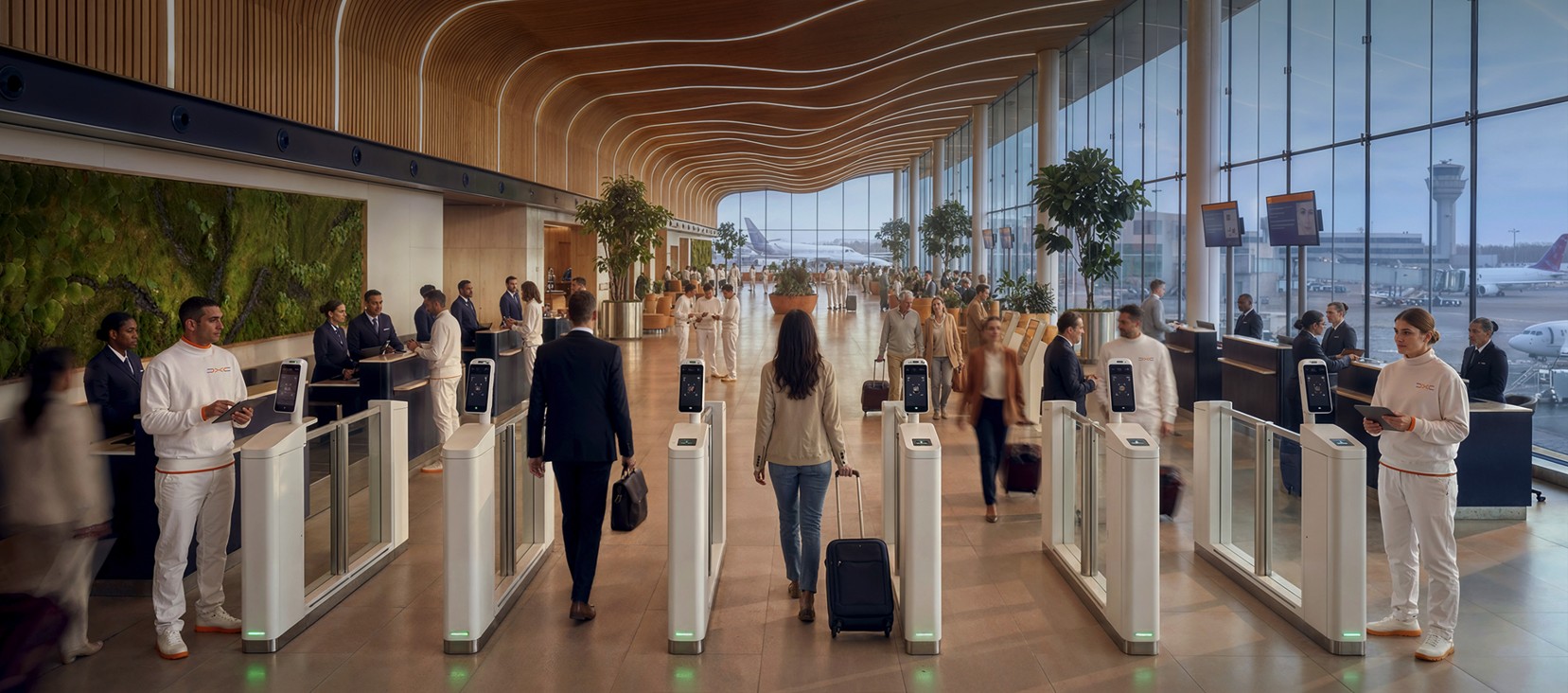
Modern airports are investing heavily in new builds and expansions, yet success depends on more than physical infrastructure. Technology must be treated as a foundational pillar to ensure systems work together, stakeholders align, and airports deliver resilient, sustainable operations alongside frictionless passenger experiences.
As an example, airports across Asia Pacific and the Middle East are on track to welcome roughly two billion additional passengers by 2040. To meet that demand, the region is investing approximately $240 billion between 2025 and 2035 in new airport builds, terminal expansions, and runway upgrades. The stakes are high with large scale critical infrastructure programs essential for maintaining the everyday operations for these international hubs.
DXC Technology is trusted by airports across the globe to plan, integrate, manage and govern complex technology environments. Bringing decades of industry knowledge, enterprise technology expertise and proven Master Systems Integrator (MSI) governance to programs where time, safety, security, sustainability, and operational continuity are non-negotiable. Through managed services to advisory & implementation, we ensure the governance frameworks, architecture leadership, and industry expertise needed to deliver complex airport technology programs on time, on budget, and to full operational readiness.
DXC Technology was a Gold Sponsor at Passenger Terminal Expo (PTE) Asia 2026, the inaugural Asia edition of the world's leading airport terminal modernisation event.
PTE Asia 2026 brought together airport leaders from across the region. DXC's Airport modernisation experts presented during the conference sharing insights on how airports can modernise at speed, with scale: Gordon Heap’s session on ‘Tomorrow's Airports … Today’ featured DXC’s approach to helping Airports realise operational improvements moving from current state to future state through governance-led functional design, solution definition and enterprise architecture; Daniel Biondi hosted an engaging panel on ‘Designing the Airport of Tomorrow – Digital Masterplanning in Asia’, bringing together some of the region's top airport leaders for a candid discussion on what it takes to build the airports of the future – where infrastructure needs to evolve and support requirements today and for decades to come.
▪ Airport investment in modernisation is growing across the region
▪ Early stakeholder alignment around core business objectives is key
▪ Integration is essential to build a connected technology ecosystem
▪ Creating consistent and seamless passenger experiences is a top priority
One common thread kept coming through: as airports grow, a trusted master systems integrator is the key to bringing it all together, with a solid foundation, for now and the long term.
DXC has been selected as the Master Systems Integrator to deliver the digital foundation for Perth Airport's new terminal development, a key milestone in the airport's multi-billion-dollar investment to transform its infrastructure and support Western Australia's long-term economic growth.
We are proud to be partnering with DXC who will bring important industry knowledge and experience to this once-in-a-generation infrastructure investment.
Selected as Master Systems Integrator, DXC built the foundational technology platforms to enable Western Sydney International (Nancy-Bird Walton) Airport to become a full-service, digitally enabled airport.
DXC Technology brings more than 40 years of experience running technology operations for airports, airlines, and air transportation organisations across the globe. This deep industry expertise combined with our proven Master Systems Integration capability reduces risk, improves sustainability outcomes, and delivers robust governance across complex information technology and operational systems, while supporting on-time, on-budget delivery for major infrastructure programs. What airport leaders get:
across IT and operational systems—one source of visibility across vendors and technologies.
through clear technology scope, governance and integration planning—minimising delays and cost blowouts.
aligned to complex multi‑party ecosystems and time‑critical programs.
from advisory through build/integration to maintain/operate.
to reduce emissions, operational waste and environmental impact across airport operations
helping to define technology scope early and to align it to broader build plans, reducing late-stage changes, disjointed requirements and avoidable rework.
establishing the technology foundations required to run a new airport from day one, supporting seamless operations and a digital passenger experience.
integrating new capabilities into live airport environments, minimising disruption during terminal expansion and operating transitions.
Airports don't stop, neither should the technology behind them. DXC manages the critical technology environments that underpin daily airport operations, providing continuity, governance, and a pathway to modernisation without disruption. We become an extension of your team, running complex multi-vendor ecosystems so operations remain resilient, secure, and ready to evolve.
We run the technology that keeps airports moving, so your teams can focus on the business of running an airport.
Managed service offerings:
▪ End-to-end IT operations management across airport technology environments
▪ Multi-vendor coordination and governance across complex supplier ecosystems
▪ Proactive service management, incident response, and continuous improvement
▪ AI-enabled operational insights to reduce costs and shift spend from CapEx to OpEx
▪ Security and compliance management for critical national infrastructure
▪ Technology roadmap advisory — aligning operational spend to long-term airport strategy
| 40+ | Top10 | 24/7 |
| Years of aviation partnerships | Of the world's busiest airports partner with DXC | Mission-critical operations support across global time zones |
When the program has a defined scope, a deadline, and no room for failure, DXC delivers. We execute complex airport technology projects from requirements through to commissioning, bringing the governance, integration expertise, and industry knowledge to land outcomes on time and on budget and to full operational readiness.
Whether it's a platform migration, a system implementation, or a full technology refresh, we treat every project as mission-critical.
Project services offerings:
▪ Technology program management for defined-scope airport initiatives
▪ System design, build, integration, and testing through to operational handover
▪ Platform migrations and upgrades with minimal disruption to live environments
▪ Common-Use Infrastructure Services (CIS) transitions and modernisation
▪ Vendor-agnostic technology selection and integration planning
▪ Stakeholder coordination across airport operators, airlines, and government bodies
| 60+ | 100+ |
| Systems integrated at one international airport | Integrations designed, built and tested, all key milestones achieved |
Master Systems Integration (MSI) is what sets DXC apart. We act as the single point of accountability for your entire airport technology ecosystem, designing the architecture, governing the program, advising on the optimal systems, and ensuring every technology works together from day one.
We design, integrate, test, and commission entire technology ecosystems, vendor agnostic, future-ready, and built for scale.
Master Systems Integration Expertise:
▪ Architecture leadership and technology governance across the full program lifecycle
▪ Design, integration, testing, and commissioning of all IT and OT systems
▪ Coordination across construction partners, technology providers, and airport stakeholders
▪ Interoperability oversight for systems used by airlines, ground handlers, retailers, and government agencies
▪ AI, cloud, and cybersecurity integration into the connected airport ecosystem
▪ Flexibility by design, no vendor lock-in, giving airports the ability to evolve as innovation demands
| 30+ | 70+ |
| Years of aviation experience brought to every engagement | IT and OT systems being integrated at one airport's new terminal |
Talk to DXC Technology about building a more connected, resilient, and passenger-ready airport — across greenfield and brownfield programs.


The future of aviation infrastructure lies in creating innovative and integrated ecosystems that pave the way for the future of air travel.
As airports evolve to meet growing demand, higher passenger expectations and increasing operational complexity, infrastructure upgrades present a compelling opportunity to fundamentally reimagine how technology underpins both the traveller journey and operational efficiency.
A truly frictionless airport experience means integrating services together so that passengers, staff and operators interact with one connected ecosystem, not dozens of disconnected touchpoints.
In a tightly connected ecosystem, where supply chains are both critical to operations and vulnerable to attack, even a single disruption can trigger ripple effects costing the aviation industry millions.
Western Sydney Airport has also contracted DXC Technology, a company with a proven track record of delivering IT services to some of the world’s biggest organisations, to design and deliver the airport’s technology framework that will allow more than 60 technology systems to talk to each other to deliver a fast, seamless journey for customers.
DXC will be responsible for building the airport’s foundational technology platforms in preparation for its opening in 2026 and its ongoing operations.
Undergraduate students at Western Sydney University are being provided with opportunities to work directly with lead designers, technologists, and business stakeholders at Western Sydney International Airport (WSI) and technology services company DXC Technology on real-world research and design projects.
Undergraduate students at Western Sydney University are being provided with opportunities to work directly with lead designers, technologists, and business stakeholders at Western Sydney International Airport (WSI) and technology services company DXC Technology on real-world research and design projects.

From mission planning to operational readiness, defense organizations rely on trusted intelligence, secure digital technologies and real-time decisions. DXC enables armed forces and prime contractors to harness AI to coordinate complex operations, accelerate response and strengthen outcomes.

The world's most critical financial systems run on trust. As banks, asset managers and wealth firms modernize core infrastructure and harness intelligent automation, they need proven technology that performs at scale — without compromise. DXC is that foundation.
DXC works with airports to navigate the most challenging aspects of modernizing existing infrastructure or delivering entirely new terminal developments. DXC's Master Systems Integrator (MSI) model places a single, accountable partner at the center of a complex technology program — coordinating design, procurement, delivery, testing, and transition to operations across the full scope of airport systems.
From passenger processing and self-service infrastructure to cloud and AI-enabled operations management, DXC brings deep airport technology expertise and a disciplined delivery governance model to programs of significant scale and complexity. A truly frictionless airport experience requires all systems — flight information, baggage, security, wayfinding, retail, and airfield operations — to function as one connected ecosystem rather than a collection of disconnected technologies. DXC helps airports achieve that integration.
Airports sit at the center of a complex ecosystem involving airlines, ground handlers, retailers, security agencies, and surface transport providers. DXC helps airports break down data silos and integrate these stakeholders and their systems to deliver a seamless passenger journey — from pre-travel planning through to departure gate.
This includes capabilities such as real-time wayfinding, baggage tracking, biometric identity processing, dynamic queue management, and personalized passenger communications. The result is a more connected, lower-friction experience from curb to gate — and more actionable operational intelligence for airport teams managing the complexity behind it.
Airports generate significant volumes of data across security, terminals, baggage systems, aprons, retail, and transport connections — yet many operators still struggle to translate that data into real-time operational decisions.
DXC helps airports build the data platforms, integration architecture, and AI capabilities needed to predict congestion, optimize gate assignments, improve security throughput, and reduce aircraft turnaround times. By applying analytics and machine learning to live operational data, airport teams can move from reactive incident management to proactive, intelligence-led operations. DXC designs these capabilities with appropriate human oversight built in — ensuring AI-generated recommendations remain transparent, auditable, and aligned with the safety-critical standards airports require.
Large airport technology programs involve dozens of specialist vendors, complex interdependencies between digital and physical systems, and significant integration risk. Without a single integrating authority, airports often face fragmented delivery, duplicated effort, scope gaps at system boundaries, and costly delays when things go wrong.
A Master Systems Integrator (MSI) acts as the airport authority's single point of accountability for the end-to-end technology program. The MSI leads architecture and solution design, manages vendor selection and coordination, owns end-to-end testing across all systems, and governs the transition to operations. For airport authorities undertaking major capital programs, the MSI model substantially reduces delivery risk, protects technology investment, and ensures the final solution functions as a coherent whole — not a collection of independently delivered parts.
DXC is experienced in the MSI model across complex infrastructure programs, bringing the governance frameworks, technical leadership, and vendor-agnostic advisory capability that this role demands.
Airports are critical national infrastructure, and the consequences of a cybersecurity failure extend beyond data — they affect operational continuity, passenger safety, and regulatory compliance. DXC treats cybersecurity as a foundational design requirement, not an afterthought.
DXC's airport security approach spans cyber defense, digital identity, data security, endpoint protection, and operational technology (OT) security — including the industrial control systems that underpin airfield and terminal infrastructure. DXC also designs for governance, risk, and compliance requirements specific to the aviation sector, including alignment with frameworks mandated by national regulators.
This includes capabilities such as security information and event management (SIEM), multi-factor authentication, role-based access control, network segmentation between IT and OT environments, and data loss prevention — all designed to protect both passenger-facing systems and the critical operational infrastructure behind them.
Delivering technology programs in airports presents a distinct set of challenges: 24/7 operational continuity requirements, safety-critical airside environments, interfaces with construction programs, and the need to integrate with existing legacy systems while transitioning to new platforms.
DXC brings structured delivery methodology suited to these constraints — including phased transition planning, Operational Readiness and Airport Transition (ORAT) alignment, interface management with construction contractors and lead design consultants, and rigorous end-to-end testing across all integrated systems before go-live. DXC also manages the full suite of stakeholder relationships that a major airport program demands, from airline partners and ground handlers through to regulators and terminal operators.
The result is a delivery model that respects operational reality — protecting the airport's day-to-day performance while progressively building and commissioning the technology capabilities of the future.
Yes. The demands are meaningfully different, and DXC's approach adapts accordingly.
Greenfield terminal programs offer the opportunity to design integrated technology systems from first principles — establishing the right architecture, data platforms, and operational systems without the constraint of legacy infrastructure. DXC brings architecture leadership and solution design capability to help airport authorities make decisions at the design stage that will support operational efficiency and scalability for decades.
Brownfield modernization involves navigating a different set of challenges: retiring or integrating legacy systems without disrupting active operations, managing technical debt, and sequencing investment to deliver near-term value while building toward a longer-term architecture. DXC has the experience to assess existing environments, identify integration opportunities, and design pragmatic migration pathways that minimize operational risk and protect existing capital investment.
Sustainability is increasingly a core design criterion for airport capital programs, driven by regulatory requirements, airline partner commitments, and community expectation. DXC contributes to airport sustainability objectives through intelligent technology design.
This includes capabilities such as smart building management systems that optimize energy consumption across terminal assets; operational analytics that reduce unnecessary aircraft movements, idle times, and resource waste on the apron; demand-responsive infrastructure management; and data platforms that support the measurement and reporting of carbon and energy performance against net-zero commitments.
DXC also brings experience integrating the technology systems needed to support emerging sustainability infrastructure — including electric ground support equipment, EV charging networks, and sustainable aviation fuel (SAF) management — into the broader airport operational ecosystem.
Vendor lock-in is a significant risk in airport technology programs, where contracts can span decades and technology landscapes shift rapidly. DXC approaches solution design with a vendor-agnostic philosophy — recommending the right technology for each requirement rather than defaulting to a proprietary stack.
In practice, this means DXC designs integration architectures based on open standards and published APIs, ensures that data and configuration assets remain the property of the airport authority, and structures vendor relationships so that individual system components can be replaced or upgraded without cascading rework across the broader technology estate.
This approach also means DXC can act as a genuinely independent advisor to the airport — evaluating technology options on their merits, negotiating on the airport's behalf, and protecting the authority's long-term commercial interests throughout the program.